¹H-NMR is the most routinely used technique in organic chemistry. Every distinct proton environment in a molecule produces a signal, and the chemical shift of that signal reflects the electronic environment around the hydrogen — shielded or deshielded by nearby electronegative atoms, π-systems, and ring currents. Assigning those signals means connecting each peak in the spectrum to a specific set of protons in the structure.
This guide walks through a complete assignment of a real spectrum using the MID ¹H-NMR Peak Identifier, signal by signal.
The molecule
The compound used in this example is tetrahydrofuran (THF) — a saturated five-membered cyclic ether, one of the most common solvents in synthetic chemistry.
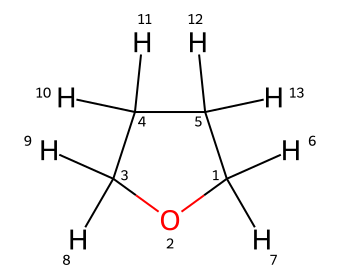
THF has the molecular formula C₄H₈O. The ring contains an oxygen at position 2, flanked by two equivalent OCH₂ carbons (C1 and C3), which are in turn connected to two equivalent β-CH₂ carbons (C4 and C5). The molecule has a plane of symmetry passing through the oxygen and bisecting the C4–C5 bond, which makes C1 equivalent to C3 and C4 equivalent to C5.
This symmetry reduces eight protons to two observable signals in the ¹H spectrum:
| Signal | Protons | Environment | Integral per signal |
|---|---|---|---|
| ~4.24 ppm | H6, H7 (C1) | OCH₂ — methylene adjacent to oxygen | 2H |
| ~4.24 ppm | H8, H9 (C3) | OCH₂ — methylene adjacent to oxygen | 2H |
| ~2.03 ppm | H10, H11 (C4) | β-CH₂ — methylene two bonds from oxygen | 2H |
| ~2.03 ppm | H12, H13 (C5) | β-CH₂ — methylene two bonds from oxygen | 2H |
Because the two OCH₂ groups are chemically equivalent, H6/H7 and H8/H9 resonate at exactly the same frequency and appear as a single peak. The same applies to the two β-CH₂ groups. The spectrum therefore shows two signals, each with a total integration of 4H — but it is important to understand that each signal corresponds to two separate CH₂ groups of 2H each, not to a single four-proton environment. When entering signals into the peak identifier, the correct integral for each pair is 2, reflecting the environment of one CH₂ unit.
The spectrum
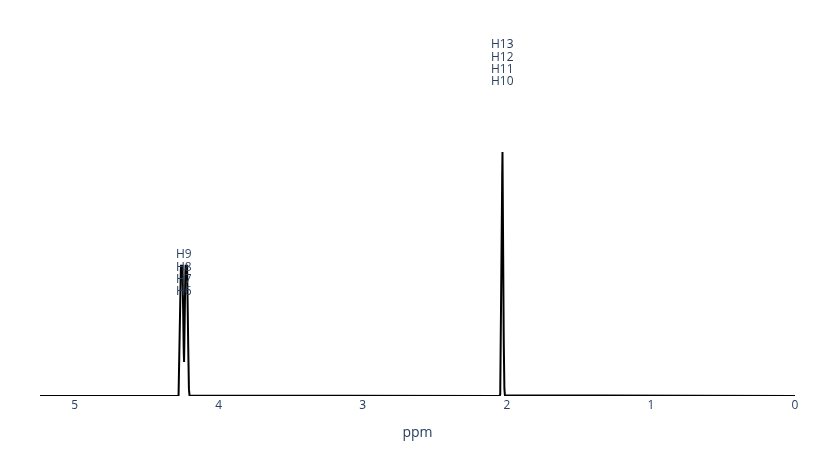
The spectrum shows exactly two signals. The downfield signal near 4.24 ppm (labeled H9 in the simulation, representative of all OCH₂ protons) is characteristic of a methylene group directly bound to oxygen. The upfield signal near 2.03 ppm (H10–H13) belongs to the β-methylenes, which are further from the oxygen and therefore more shielded.
With the two environments identified, let us run each one through the peak identifier using an integral of 2.
Using the ¹H-NMR Peak Identifier
The Peak Identifier works by comparing each entered chemical shift and integral against a database of quantum-chemically calculated proton environments. For each signal, it returns a ranked list of the most probable hydrogen environments — represented as small structural fragments showing the connectivity around the proton in question (the red sphere). The percentages reflect how well the entered parameters match each environment in the database.
4.24 ppm, integral 2 — OCH₂ protons (H6/H7 and H8/H9)
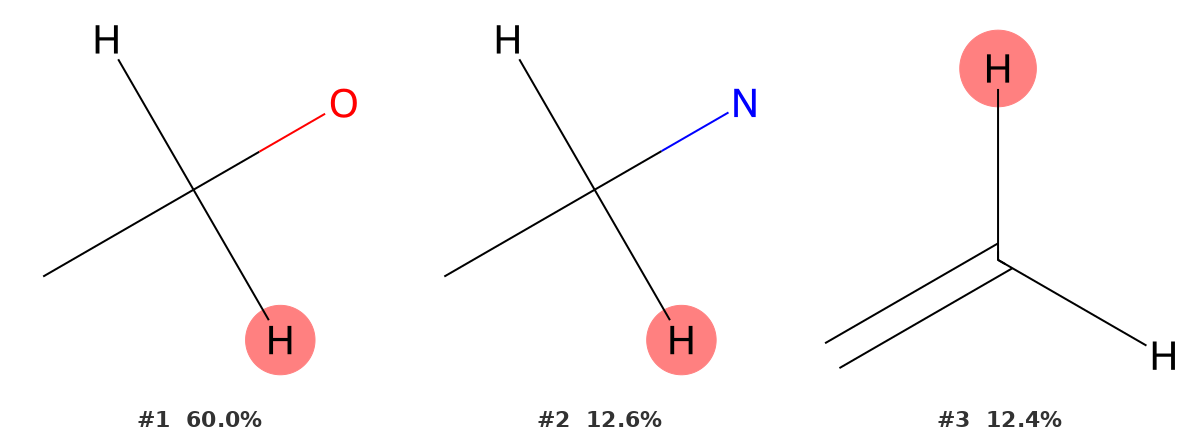
The signal at 4.24 ppm belongs to the methylene protons on C1 and C3, the two carbons bonded directly to the ring oxygen. The identifier returns CH₂ adjacent to oxygen as the top result with a probability of 60.0%. The fragment shown is a carbon bearing two hydrogens and one bond to an oxygen — exactly the environment of the OCH₂ groups in THF.
The second-ranked result (CH₂ adjacent to nitrogen, 12.6%) and the third (vinyl CH₂, 12.4%) together account for most of the remaining probability. Both nitrogen-adjacent and oxygen-adjacent methylenes appear in similar shift ranges (3.5–4.5 ppm), so some overlap is expected. However, the oxygen environment ranks first by a comfortable margin, and in context — knowing the molecular formula contains O and no N — the assignment is unambiguous.
Note that this result is entered and interpreted twice: once for H6/H7 (C1) and once for H8/H9 (C3). Both pairs give the same result because they share the same chemical environment. The integral of 2 correctly represents one CH₂ unit; the observed integration of 4 in the full spectrum arises from the two equivalent pairs coinciding at the same shift.
2.03 ppm, integral 2 — β-CH₂ protons (H10/H11 and H12/H13)
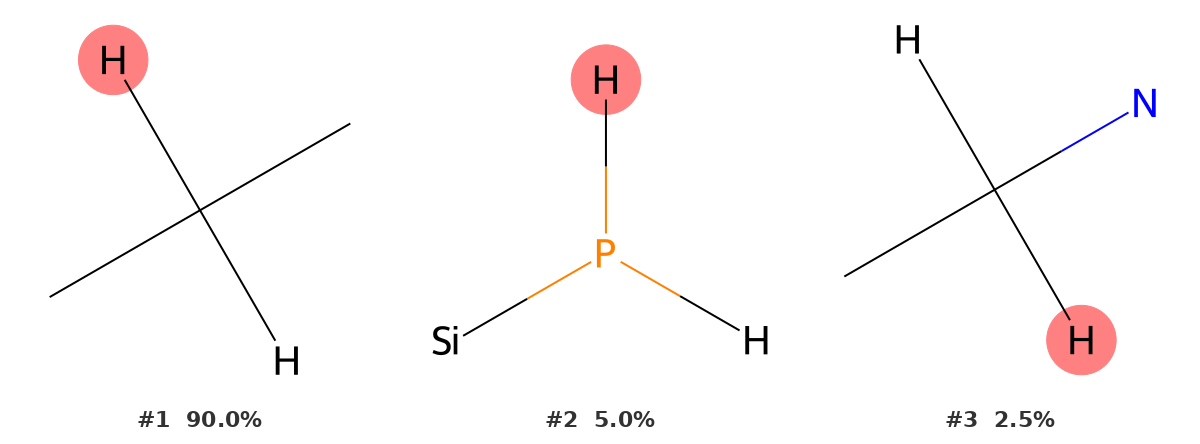
The signal at 2.03 ppm belongs to H10/H11 and H12/H13 on C4 and C5 — the two β-methylenes, each sitting two bonds away from the oxygen. The identifier returns a CH₂ in an aliphatic carbon chain as the top result with a probability of 90.0% — the highest confidence result in this example.
The fragment shown is a methylene carbon (two H, two C bonds) with no electronegative substituents directly attached, which is precisely the environment of C4 and C5 in THF. The gap between the top result (90.0%) and the second-ranked environment (P-H at 5.0%) is very large, reflecting how diagnostically distinctive the 2.0 ppm region is for simple aliphatic methylenes.
As with the OCH₂ signal, the integral of 2 is entered for one CH₂ unit. The signal integrates for 4H in the full spectrum because H10/H11 (C4) and H12/H13 (C5) are chemically equivalent and overlap exactly. Each pair contributes 2H; together they give the observed integral of 4.
Summary
The table below collects all assignments, listed by signal:
| Shift (ppm) | Integral entered | Protons | Identifier rank | Probability | Correct? |
|---|---|---|---|---|---|
| 4.24 | 2 | H6/H7 — OCH₂ (C1) | #1 | 60.0% | ✓ |
| 4.24 | 2 | H8/H9 — OCH₂ (C3) | #1 | 60.0% | ✓ |
| 2.03 | 2 | H10/H11 — β-CH₂ (C4) | #1 | 90.0% | ✓ |
| 2.03 | 2 | H12/H13 — β-CH₂ (C5) | #1 | 90.0% | ✓ |
Both signals are correctly identified by the top-ranked environment. The complete assignment is consistent with the structure of THF: two OCH₂ environments at 4.24 ppm and two β-CH₂ environments at 2.03 ppm, with all protons accounted for.
A note on integrals and molecular symmetry
THF illustrates a general principle that applies to any symmetric molecule: a single peak in the spectrum can represent multiple chemically equivalent environments. The observed integral of 4 for each THF signal does not mean there is a four-proton environment — it means two distinct two-proton environments happen to resonate at exactly the same frequency.
When using the peak identifier, always enter the integral that corresponds to a single chemical environment, not the total integration of the peak. For THF, the correct input is 2 in both cases. Entering 4 would imply a four-proton environment at a single carbon, which does not exist in this molecule and would return a less accurate match.
This counting step — determining how many chemically distinct environments contribute to each observed signal — is the first thing to establish before running any signal through the identifier. In THF it is straightforward because the symmetry is obvious; in more complex structures, it requires a careful look at the molecular symmetry elements.
Conclusions
The ¹H-NMR Peak Identifier handles both common aliphatic environments encountered in cyclic ethers: oxygen-adjacent methylenes and β-methylenes in carbon chains. The workflow is the same as for any other molecule — enter each signal with its chemical shift and the integral for a single chemical environment, then match the ranked results against the proposed structure.
For symmetric molecules like THF, the key step is recognising that an observed integral of 4 (or 6, or 8) may arise from multiple equivalent groups rather than from a single large environment. Entering the correct per-environment integral ensures the tool returns the most accurate ranked list.
Try it with your own spectra at moleculeidentifier.com/hnmr_LO.